Can there be a “just war”?

Summary of the Wellington Abrahamic Council roundtable on “Can there be a just war?”

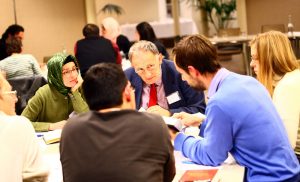
On Tuesday evening 23 June 2026, the Wellington Abrahamic Council of Jews, Christians, and Muslims held a closed roundtable discussion, with three each of Jewish, Christian, and Muslim discussants to explore the question “Can there be a just war?” The meeting was held under the Chatham House Rule.

Framing and ground rules

The evening opened with a reminder of the Council’s shared values: assuming good faith, being curious, forgiving offence taken as unintentional, and reaching decisions by consensus. The convenor noted that holding such a conversation safely depended on years of trust-building, and that even within each faith tradition there were many points of view, not always congruent.

The Jewish perspectives

One speaker argued that Judaism lacks a formal just war theory, since for nearly two millennia (70 CE to 1948) the Jewish people lived without political sovereignty or standing armies. Drawing on rabbinic thought, they framed war as a “social aberration” and a deviation from the ideal. They cited the distinction between obligatory wars (self-defence) and discretionary wars (for power), warning of a “slippery slope” where a defensive war can morph into a war of choice. Using the Deuteronomy injunction against destroying fruit trees during a siege, they stressed that a righteous cause grants no “blank cheque,” and that combatants remain morally responsible for foreseeable harm. The conclusion: war can be just, but only as administered under the strictest moral limits.

A secular Jewish speaker rejected religion as a reliable guide, noting that scripture has been used to justify atrocities, but affirmed belief in just wars as codified in international law. They walked through the framework of when war is justified, how it must be conducted (distinguishing combatants from civilians, proportionality, treatment of prisoners), and emerging questions of justice after war. They highlighted the contribution of Jewish jurists to concepts like genocide and crimes against humanity, while arguing that much recent conduct in the Middle East cannot be justified under international humanitarian law. They also made the point that although the group of people in the room were open to this conversation, we could have had a different group of people from each of the three Abrahamic religions in the room that would have been very hostile to each other.

A third speaker, less focused on theology, reflected on the value of interfaith dialogue itself and expressed concern about rising antagonism towards the Jewish community in wider society, and the difficulty of extending the calm of such discussions into the broader public.

The Christian perspectives

One speaker reframed “just war theory” as “violence-reduction criteria” – not a moral validation of war but a set of rules to mitigate its impact. They contrasted punitive justice (what rule was broken, who is to blame, what punishment) with restorative justice (what happened, who was affected, what is needed to put things right), arguing that, theologically, justice is about restoring broken relationships and therefore no war can be truly “just.”

Another Christian speaker traced the evolving Catholic position, citing Pope Leo’s recent statement that just war theory is now “outdated,” and noting the moral as well as material damage of war. They argued, however, that the traditional criteria – especially “reasonable prospect of success”, “competent authority”, and “last resort” – still carry weight and should not be discarded, even as unilateralism and new warfare make a just war increasingly hard to envisage.

A further reflection invited a broader, eternal perspective: that the human yearning for peace and mercy reflects the divine image, and that those who never receive earthly justice might place hope in a just and merciful God, who enables us to forgive and bless even those who are repulsive to us.

The Muslim perspectives

Speakers emphasised that Islam treats peace as a core value and permits war only under strict conditions – self-defence and protection of the oppressed, never aggression. Strict rules forbid harming civilians, destroying crops, or mistreating prisoners. One speaker clarified that jihad is primarily an inner struggle against one’s instincts, not religious warfare.

A central contribution focused on the aftermath of war: the duty to pursue peace when the enemy inclines towards it, to act with justice and reconciliation even towards former enemies, and to embrace forgiveness over revenge. The conquest of Mecca without bloodshed as related in the Qu’ran was offered as the model. War is never an end in itself; the true test of faith begins when the weapons fall silent.

Recurring themes from the general discussion

Several threads united the traditions. There were strong resonances across all three faiths – protection of non-combatants, prohibition on destroying the environment, and peace as the ultimate aim. Many speakers questioned whether the very framing – “is this war just?” – already concedes too much, and that the more important question is how to construct peace, which must be built intentionally over time rather than treated as the mere interval between conflicts.

Participants noted two contemporary shifts that strain just war theory: the breakdown of international legal norms and multilateralism, and the rise of autonomous weaponry and AI, which raises unanswerable questions of moral accountability when machines, not people, make lethal decisions.

A former service member observed that just war is rarely discussed within the military itself, that such decisions rest at the highest political levels (citing historical examples of leaders developing misgivings about bombing campaigns), and that the framework is heavily Eurocentric. This prompted a suggestion to engage military chaplaincy in the conversation.

Where the group landed

There was appetite to continue with a follow-up session reframed around building “just peace” rather than just war, to consider producing a joint statement capturing the resonances, and to explore practical outreach, such as educational resources that surface a counter-tradition of peacemaking within national history. The evening closed with a reflection on refugees as the human cost of war, and a hope to work towards a day when refugees no longer exist.
Wellington Abrahamic Council Condemns Bondi Attack

The Wellington Abrahamic Council of Jews, Christians, and Muslims is deeply shocked by the horrific murder of Jewish people attending a Hanukkah celebration in Sydney on December 14. We express our profound sympathy for the families of all those directly affected and recognize the impact on all Jewish people living in Australia, Aotearoa New Zealand and all around the world.

This terrible event reflects a resurgence of public anti-Semitism in many countries in recent years, along with other forms of racism and religious discrimination. Our algorithmically driven communication systems are designed to spread ideologies of hate, disinformation and extremism overseas and here in Aotearoa New Zealand.

Like similar events in other countries this mass murder appears to be an outcome of this trend. While our governments both have dedicated teams addressing this issue, this tragic event suggests the extent of this evil in our societies requires an increase in resources to maintain surveillance of groups that have the potential to engage in terrorist activities, and increased protection for vulnerable communities.

The Wellington Abrahamic Council affirms that all religious communities should be free to practice their particular religion and way of life without fear of discrimination or any interference. All three Abrahamic religions teach the inherent dignity of all human individuals and groups of any culture or religious affiliation. We recognize human diversity as a blessing from the divine Creator of all that is.

As a Council we continue to reject all ideologies of division and hatred directed towards any ethnic or religious group. We believe that increased understanding between religious communities will lead to deeper respect for all of those people who practice these religions. Ongoing dialogue with one another remains the only way forward for us all. We believe that dialogue leading to increased understanding between religious communities and others leads to deeper respect for all people.

Nick Polaschek Christian Co Chair
Rito Triumbarto Muslim Co Chair
Dave Moskovitz Jewish Co Chair

Upholding Religious Freedom and Respect for All

Joint Statement from New Zealand Faith Communities

As leaders and representatives of diverse religious communities across Aotearoa New Zealand, we are united in our concern about the messages promoted during the public protest held on June 21, 2025 by Brian Tamaki and his followers against immigration and the spread of non-Christian religions in New Zealand.

The right to protest is a cornerstone of democracy. However, we are saddened to see rhetoric that appeared to diminish the place of some faiths in New Zealand’s multicultural society. Our religious traditions may differ, but we all share a common commitment to compassion, dignity, and the peaceful coexistence of communities.

New Zealand’s strength lies in its diversity, including its religious diversity. The freedom to worship, or not to worship, is a value we all cherish. We believe that no one faith should be positioned as having greater legitimacy than others in the life of our nation.

We encourage dialogue rather than division, and understanding rather than suspicion. In times of tension, it is especially important that we come together in the spirit of unity and mutual respect.

We remain committed to working together across our faiths to uphold these values and to support the inclusive, respectful society that we all seek to build.

Endorsed by:

New Zealand Jewish Council
NZ Central Sikh Association
Hindu Foundation NZ
Somaliland Society in New Zealand Incorporated
Wellington Abrahamic Council

Sharing Our Scriptures 2018

Sharing our scriptures: an Abrahamic interfaith dialogue

When: 7.30PM Tuesday 27 February and monthly thereafter
Where:
Nick Polaschek’s home at 12 Everest Street Khandallah

You are invited to an ongoing informal discussion sharing our perspectives of the Torah, New Testament, and Koran.

The Wellington Abrahamic Council is again sponsoring a series of evening meetings to help foster understanding and friendship between people from the three Abrahamic faith traditions in Wellington.

Last year a group met monthly to reflect together on a theme expressed in a selected passage from the sacred scriptures of each of the three Abrahamic faith traditions. During the meetings each of us listens to the other participants sharing their understanding of the selected scripture from their faith traditions, in turn sharing our understanding of the scriptures from our own tradition.

Participants last year found the experience enriching and were keen to continue in 2018.

Our shared aim is to understand more deeply the perspectives of the other Abrahamic faith traditions and, in this light, to understand more deeply our own faith tradition. From this we hope to better recognize our shared understandings and values and appreciate positively our differences as faith traditions that come from Abraham, our father in faith.

The evenings will once again use Scriptural Reasoning, a tool for interfaith dialogue developed by the Cambridge University Interfaith Programme and now used in a number of countries. We will use the guidelines and text packs, available at their website.

The theme for our first meeting of 2017 is Encountering God, which can be found in the Resources section of the Scriptural Reasoning website.

Our shared aim is to understand more deeply the perspectives of the other Abrahamic faith traditions and, in this light, to understand more deeply our own faith traditions. From this we hope to better recognize our shared understandings and values and appreciate positively our differences as faith traditions that come from Abraham, our father in faith.

For more information, contact Nick Polaschek, nandlpolaschek@gmail.com or (020) 479 7956

Sharing our scriptures – a series of informal meetings

Sharing our scriptures: an Abrahamic interfaith dialogue

When: 7.30PM Wednesday 29 March and monthly thereafter
Where:
Nick Polaschek’s home at 12 Everest Street Khandallah
RSVP: http://bit.ly/sos-rsvp

The Wellington Abrahamic Council is sponsoring a series of evening meetings to help foster understanding and friendship between people from the three Abrahamic faith traditions in Wellington.

We will meet in each others’ homes to reflect together on a theme expressed in a selected passage from the sacred scriptures of each of the three Abrahamic faith traditions.

Each of us will listen to the other participants sharing their understanding of the selected scripture from their faith traditions, in turn sharing our understanding of the scriptures from our own tradition.

The evenings will use Scriptural Reasoning, a tool for interfaith dialogue developed by the Cambridge University Interfaith Programme and now used in a number of countries. We will use the guidelines and text packs, available at their website.

For the first meeting we will use the first text pack, Abraham’s hospitality, which can be found in the Resources section of the Scriptural Reasoning website.

Our shared aim is to understand more deeply the perspectives of the other Abrahamic faith traditions and, in this light, to understand more deeply our own faith traditions. From this we hope to better recognize our shared understandings and values and appreciate positively our differences as faith traditions that come from Abraham, our father in faith.

Do consider coming along on Wednesday 29 March 2017 at 7:30pm, and don’t forget to RSVP.

For more information, contact Nick Polaschek, nandlpolaschek@gmail.com or (020) 479 7956

ICCJ Conference Berlin 5-8 July

The International Council of Christians and Jews has announced its 2009 conference to be held 5-8 July 2009 in Berlin, with the theme “A Time for Recommitment: Jewish-Christian dialogue 70 years after the war and Holocaust”.

Programme:
Sunday July 5, 2009

13.00 Women’s seminar
18.00 Reception
18.30 Opening dinner
20.00 Opening session with presentation of the new ICCJ document
“A TIME FOR RECOMMITMENT:
BUILDING THE NEW RELATIONSHIP BETWEEN JEWS AND CHRISTIANS.”
including the ‘Twelve Points of Berlin’/’Zwölf Berliner Thesen’.
Guest: Dr. Wolfgang Schäuble, German Minister for the Interior

Monday July 6, 2009

07.00 Denominational prayers at hotel
07.30 Breakfast
09.00 Meditative moment
09.30 Plenary session
Christian Key note speaker (to be invited)
Jewish Respondent: Dr. Edward Kessler, Cambridge
Theme: The necessity of developing theologies of Judaism that affirm its distinctive integrity.
11.00 Workshops (contributors and moderators to be invited) on theological themes
deriving from the Twelve ICCJ Berlin Points, such as:
– Paul and Judaism
– Mutual influencing of Jewish and Christian liturgy
– 21st century forms of supersessionism
– Reform of synagogue liturgy?
– How to work with the ‘Twelve ICCJ Berlin Points’ etc.
12.30 Lunch
14.00 Workshops (contributors and moderators to be invited)
on today’s issues in Jewish-Christian dialogue, such as:
– The Roman Catholic Church under Pope Benedict XVI
– The necessity of trilateral dialogue
– The political situation in the Middle East
– The input of Asia and Africa in dialogue. Etc.
15.30 Free evening in Berlin

Tuesday July 7, 2009.

07.00 Denominational prayers at hotel
07.30 Breakfast
09.00 Meditative moment
09.30 Plenary session
Jewish key note speaker: Prof. Ruth Langer, Boston College
Christian Respondent: Dr. Barbara Meyer, Jerusalem.
Theme: Re-examining Jewish texts and liturgy in the light of Jewish-Christian dialogue.
11.30 Outing by boat on the Spree river
15.30 Break at hotel
17.30 Celebration of the 60-th anniversary of the ‘Deutsche Koordinierungsrat’ at the
Französischer Dom. Special guest: Dr. Angela Merkel, Chancellor.
19.30 Reception and dinner

Wednesday July 8, 2009

07.00 Denominational prayers at hotel
07.30 Breakfast
09.00 Meditative moment
09.30 Plenary session.
A panel with a Jewish, a Christian and a Muslim speaker. (to be invited)
Theme: ‘The common commitment for justice in the global society’.
11.00 Workshops on the non-theological points from the ‘Twelve ICCJ Berlin Points’.
13.30 Visits in Berlin: The Holocaust Memorial, The Jewish Museum and other places.
18.00 Closing event and dinner.