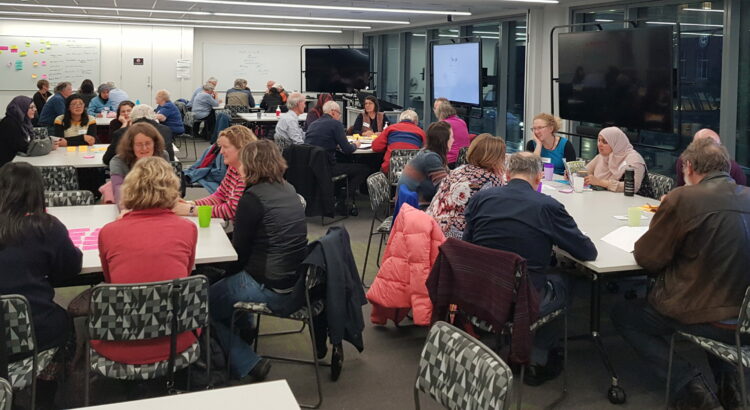
The Wellington Abrahamic Council held a Workshop on the Climate Emergency on 20 June 2021 at Te Herenga Waka / Victoria Univesrity of Wellington. Facilitated by Dave Moskovitz and Jonathan Boston the event was attended by 50+ people representing Jews, Christians, and Muslims. We heard from inspirational speakers including Sarah Livschitz, Paul Blaschke, Geoff Troughton, Amy Ross, Waseema Ahmed, Taufil Omar, Paul Morris, and Estelle Henrys.
Focussing on this vital issue together provided an opportunity to meet others from our different communities and to learn a little more about our respective traditions within the Abrahamic family. From the initial presentations by representatives of each of the three faiths it was clear that the teaching of our Abrahamic traditions about sustainability and the natural world provides a rationale and motivation to address this defining issue of our time as a priority.
During the workshop, we identified themes which were of interest to the attendees, discussed them within our own faith communities, and then brainstormed ways of working together on those themes accross our religions in small groups.
At the end of the workshop, we each filled in “commitment cards” outlining actions we were each committed to take within our own families, within our faith communities, and and within wider society.
Our meeting came up with several eco principles for faith communities
- Contributing to eco sustainability is part of our faith commitment today.
- Not just individual effort but collective eco action as faith communities is necessary.
- Eco stewardship is worship because the world is God’s creation and belongs to God.
- We need to contribute as faith communities by collaborating with other eco groups.
Our meeting identified several necessary strategies:
- We need to reinterpret our sacred texts, theologies, and faith practices in order to express eco activism as an imperative of our faith commitment.
- Any planned actions in transition to a more eco-centric society need to be just, avoiding consequences or further disadvantaging already poorer groups in our society.
- We need to be making an active contribution, as faith communities, towards the public debate on climate change issues.
- We need to form alliances with other faith communities, beyond the Abrahamic, in order to be more effective in our public contribution to climate change debates.
- Each faith community has a role of encouraging an eco-commitment among its member families at the household level.
- We need to commit to this as a long-term aim.
Becoming an Eco faith community
Each congregation or group (Synagogue, Mosque, Church, Tangata Whenua) can review the environmental impact of its activities and plant, including transport by which these are accessed by its members, in order to progressively move towards having a minimal ecological footprint as a group.
Self-assessment programme available at ecochurch.org.nz – note that most of the content and principles on this site are applicable to mosques and synagogues as well as churches.
Other available tools / resources: